The history of the Belgrade railway junction
The construction of the railway infrastructure in Serbia began in the second half of the 19th century with the construction of a railway line and a station building, with the aim of connecting it to the railway network of Europe.
- That development continued in the first half of the 20th century, but without clearly defined relationships with city structures, urban units and urban development directions of the city of Belgrade. The financing of the construction of railway infrastructure in Belgrade was under the responsibility of the Ministry of Transport, which did not achieve adequate cooperation with certain city institutions.
General plan of Belgrade 1923-1924. which contained the solution for the Belgrade railway junction, a proposal for the development of the railway infrastructure was given, the most significant of which were ideas about:
- Sava Central Passenger Station,
- Two tunnels, one from the main station, the base for the connection with the Pančevo bridge and the return one for the south direction,
- The main freight station Danube
- Makiš shunting station
- The circular railway around Belgrade with three small stations Topčider, Mokroluška and Mirijevo with the station Marinkova bara,
- Two dead-end branches from the circular railway to the military post at Banjica and the Red Cross
- Five out-of-town tunnels to connect all Belgrade railway stations that were located in the valley of the Belgrade creeks (one from the valley of the Topčider river to the Mokroluška potok, two smaller tunnels from the Mokroluška potok to the Vračar station (Crveni krst), the fourth from the Mokroluška valley to the station Mirijevo in the valley of the Mirijevsko potok and the fifth at the dead end to Banjica)
- The stretch branch from Mirijevo to Velikoselski rite, where the large port-industrial area of Belgrade is planned
- The out-of-town elements of the system consisted of three bridges: two over the Sava River (there is also a new one over Ada Ciganlija for the connection between Zemun and the Makiš marshalling station) and one over the Danube for the connection with Pancevo.
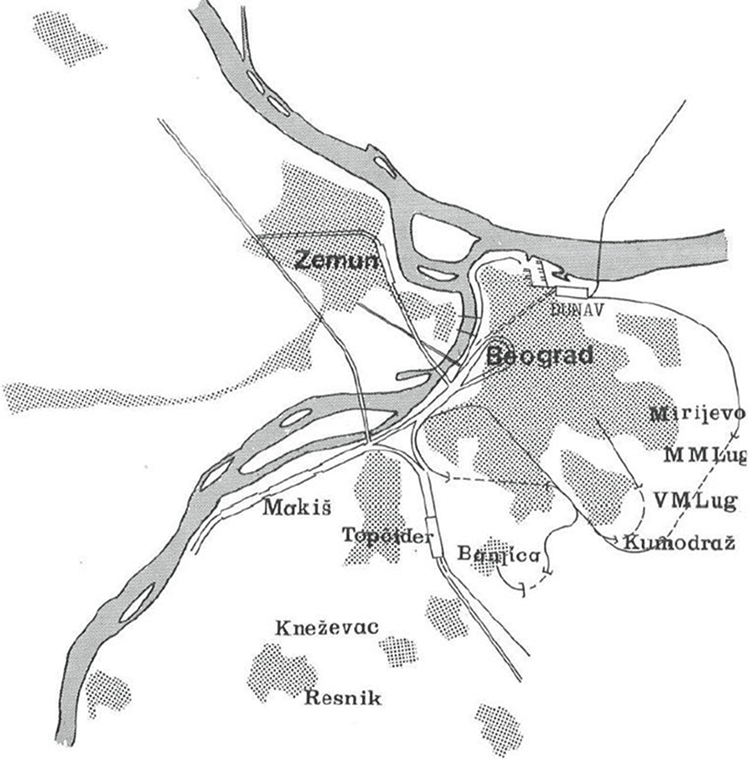
Fig. 1. Proposal for the solution of the Belgrade railway junction from 1922-1923. year
All mentioned elements of the Belgrade Railway Junction from the General Plan of Belgrade 1923-1924. They formed a unique system that had to be built in stages.
The basis of the proposed solution was the desire to separate passenger and freight traffic within the Belgrade railway junction. This kind of railway junction is planned for Belgrade with a population of 500,000.
This urban plan left the possibility of expanding the city towards the Sava River in the area of Bar Venezia.
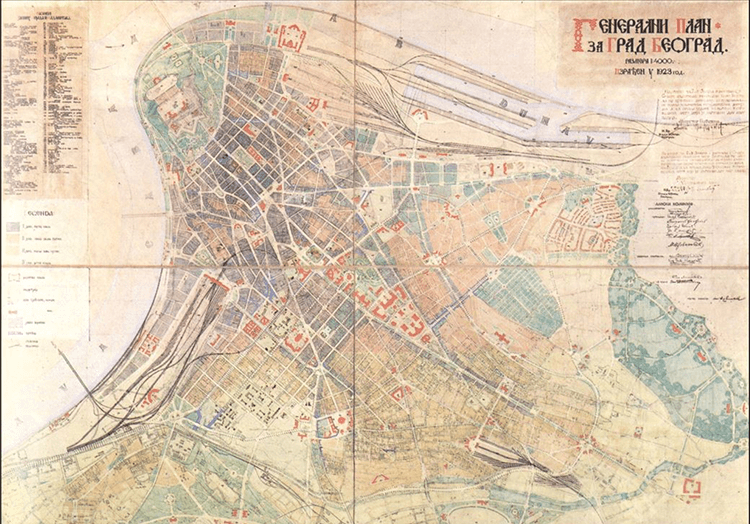
Fig. 2. Grand Prix of Belgrade 1923. Arch Đ. Kovalevski
All the projects that were carried out until the end of the Second World War contained very complicated and expensive solutions for the Belgrade railway junction, with special reference to the conditions for realization dictated by the topography of the terrain, hydrology and geology. The main passenger railway station according to all variants of the junction was supposed to remain in the area of Savamala, with the fact that, according to some solutions, it was turned into a partially passing station for the direction to Pančevo. According to all solutions, the bridge over the Danube and the bridge over the Sava for passenger traffic were retained. The construction of a new bridge over Ada Ciganlija was proposed. The connection to the Banat part of the city was solved in two ways, either by keeping the railway around Kalemegdan or by a tunnel connection under the city.
Shunting stations are planned mainly at two locations Makiš and Resnik, and locoteret ones on the circular railway or across the Sava and Danube. The development of the Srem part of the city in the context of the development of the Belgrade railway junction was not taken into account.
The cooperation between the experts in charge of railway development and urban planners was not at the required level, and as a result, the problem of the Belgrade railway junction remained unresolved.
After that, until the 70s of the last century, there were several different proposals for the solution of the Belgrade railway junction with the idea of separating passenger and goods traffic. The junction was planned to meet the needs of the residents of Belgrade, but with more or less sense for the urban development of the city, especially for the parts along the Sava and Danube rivers.
In order to reach the final proposal, SANU was engaged, which for the needs of this project formed an expert team with Academician prof. Eng. Branko Žeželje at the head.
With the participation of the Community Design Institute of the Yugoslav Railways, a new modified solution of the Belgrade railway junction was formed, with the location of the passenger station in Prokop. According to this node solution, the technical station (Zemun polje) and the passenger station (Novi Beograd) on the left bank of the Sava were retained, while several changes were made on the right bank of the Sava compared to the solution from the GUP. The passenger station was relocated from Autokomada to Prokop, and the technical passenger station was relocated from the Mokroluz valley to the part of Topčider near the settlement of Košutnjak.
The new Prokop station is connected to connecting lines to the south by a two-track tunnel under Dedinje, while the need for connections with the Banat side of Belgrade arose.
The new - modified solution of the node preserved all the characteristics of the solution from the GUP in 1950, and above all the liberation of part of the area along the banks of the Sava River and the Topčider Valley from railway facilities, as well as an even distribution of railway stations throughout the city with the aim of better serving the entire area.
The ŽTP expert council supported the passenger traffic solution based on a modified version of the GUP, with a station in Prokop.
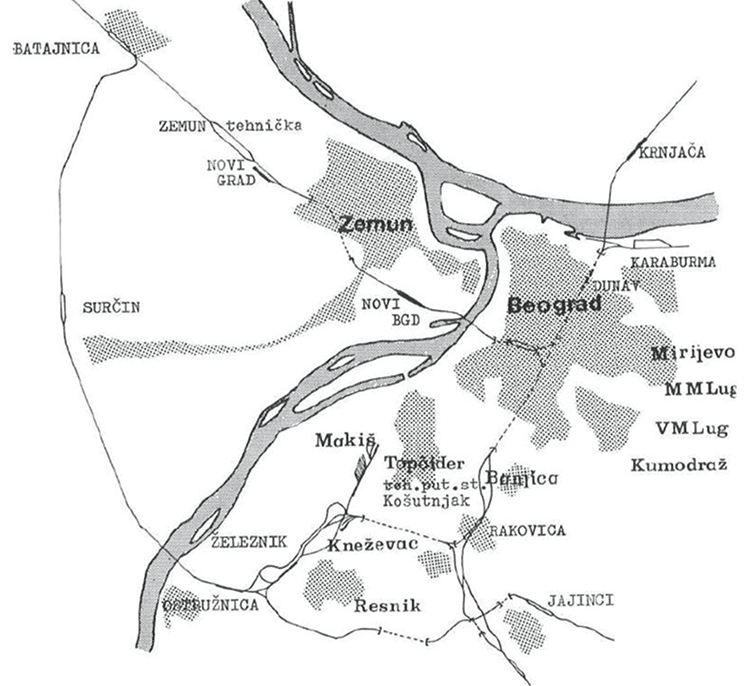
Fig. 3. Proposal for the solution of the Belgrade railway junction, variant "Prokop"
After the presentations and discussion, a vote was taken in the Commission for the General Urban Plan and the Expert Commission of the Urban Institute.
The result of the voting showed that the majority of the members of both commissions declared themselves in favor of the version of the Belgrade railway junction - "Prokop".
This decision was confirmed at the session of the Belgrade City Assembly held on March 11, 1971.
After the presentations and discussion, a vote was taken in the Commission for the General Urban Plan and the Expert Commission of the Urban Institute.
The result of the voting showed that the majority of the members of both commissions declared themselves in favor of the version of the Belgrade railway junction - "Prokop".
This decision was confirmed at the session of the Belgrade City Assembly held on March 11, 1971.
The general urban plan of Belgrade in 1972
In the General Plan of Belgrade from 1972, it was stated that the passenger railway junction was incomplete in all respects.
There are four passenger stations "Beograd - glavna", "Dunav", "Topčiderska" and "Zemun". Their position in space and the condition of their equipment do not correspond to the needs of the city, so that a large part of Belgrade (Srem) is isolated from railway traffic.
Regarding freight traffic, there are three railway transshipment stations, "Belgrade" near the main passenger station, "Donji grad" and "Zemun - Novi grad".
Their position could not be assessed as satisfactory, so measures were taken to relocate some of them.
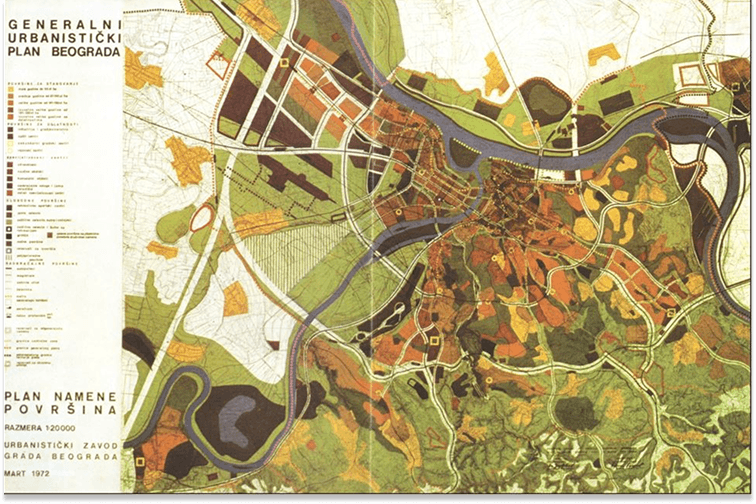
Sl. GP Belgrade 1972. Arch A. Đorđević
The urban conception of the development of the Belgrade railway junction foresees, in addition to the main railway stations in Prokop and New Belgrade, several railway stops in different parts of the city, which enables the railway system to play a role in local urban and suburban traffic.
The connection with the Banat side from the "Prokop" station will be made through the Vračar tunnel, 3543 meters long. This tunnel is planned with two stops, one near Dimitrije Tucović Square - Slavija, and the other near Vuk's monument.
The Danube tunnel, which should connect the new cargo station "Karaburma" with the "Danube station", is 717 meters long. It is planned that all four tunnels will be completed by May 1, 1978. year.
The "city train" system will open a new perspective for the development of city traffic, which will be fully synchronized with other forms of city traffic.
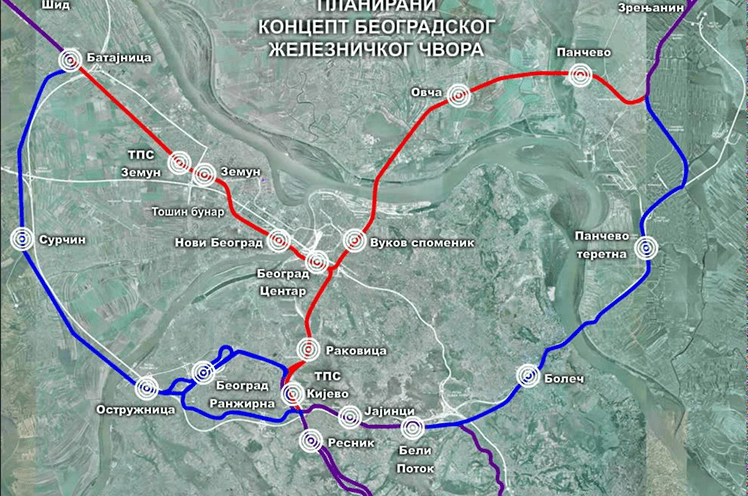
Sl. Belgrade railway junction, planned concept
History of Beovoz
Thoughts on the inclusion of railway traffic in the public transport of the city of Beorada appeared in the seventies of the last century.
The first concrete solutions were proposed by the study prepared by the city and railway services for planning and design in 1977.
The realization of this concept was made possible by the construction of the capacity of the new Belgrade railway junction, the construction of the necessary capacities in the Belgrade junction in the period from 1984 (section Zemun - Zemun Polje - Novi Beograd - Beograd Centar) - to 1995 (section Rakovica - Pančevački Most and the opening of the Vukov Spomemik stop for the reception and dispatch of passengers).
From 1992 to 1995, trains ran on two routes, Batajnica - Pančevački Most/Pančevo Varoš and Belgrade Centar/Batajnica - Resnik. In this period, the average follow-up interval was about 50 minutes.
From 1995 to 2002, the trains ran in a "circular system" on three lines. The last stations to which Beovoz ran in this period were Pančevo Vojlovica, Nova Pazova, Ralja and Velika Plana. The trains did not run in clock mode during this period.
After 2002, traffic was planned on five lines. The final stations to which Beovoz operated in this period are Pančevo Vojlovica, Inđija, Valjevo, Mladenovac, Velika Plana Umčari, Požarevac. In this period, trains on the route to Pančevo Vojlovica operated in a 60-minute clock system, while trains on other routes had three departures per day.
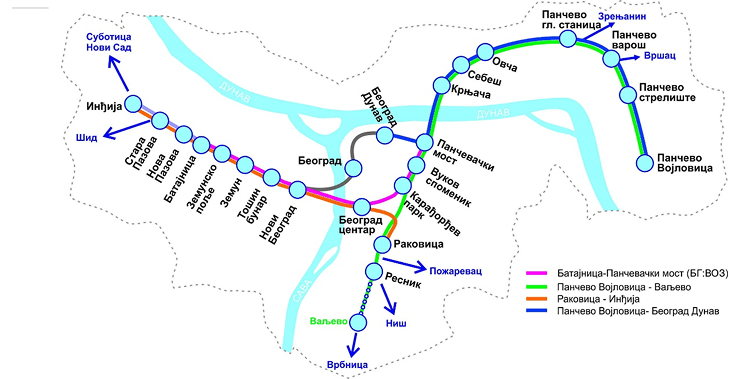
With the development of the BG: train starting in 2010, the number of routes operated by trains from the Beovoz system is reduced, as well as the number of scheduled departures. So that trains from the Beovoza system In 2016 and 2017, they operate only on the route from Pančevo Most, that is, Ovča to Pančevo Vojlovica.
With this reduction, the traffic of trains from the Beovoz system is canceled in December 2017.
History of BG:voza
The BG:voz system represents the basis of the urban and suburban railway system in the area of the city of Belgrade.
Before the establishment of the first line of BG:voz, in the territory of the city of Belgrade, Beovoz operated, which connected Pančevo, Valjevo, Inđija, Mladenovac and Požarevac with Belgrade.
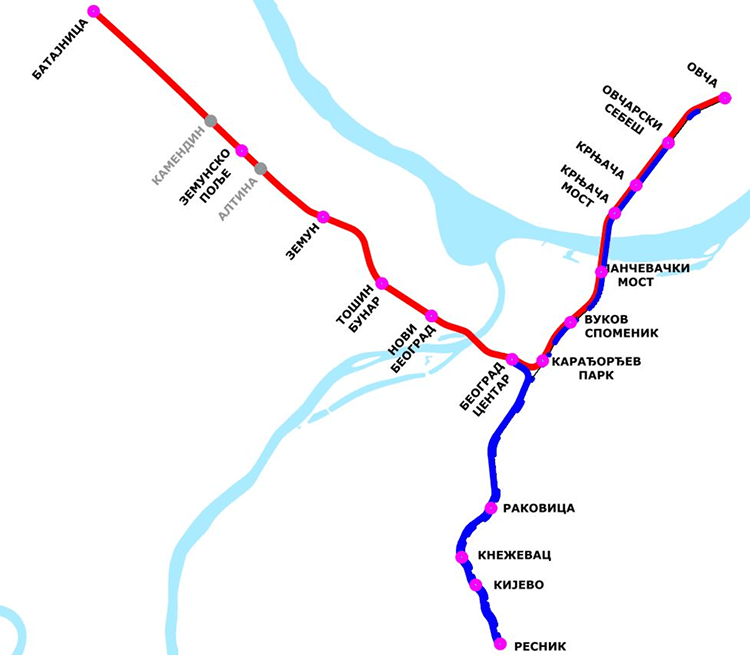
With the great enthusiasm of a small number of people and the desire to improve transportation conditions in the city of Belgrade on September 1, 2010. the first line of BG:voza, Line 1., which operated from the Novi Beograd railway station to the Pančevački most railway station, begins operation. The line was 7.6 km long and had five stations.
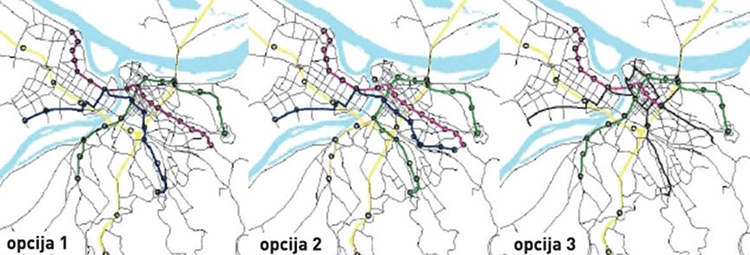
Today, Line 1 runs from Batajnica to Ovča. It is 31.3 km long, has 15 stations, and the journey time is 50 minutes.
Beginning in 2018, a second Bg:voza line was established, Line 2, from Resnik to the Belgrade Centar railway station. Since February 2019, Line 2 has been extended to Ovča. The line is 23 km long, has 11 stations, and the travel time from Resnik to Ovča is 40 minutes.
Line 3 and Line 4 started operating in 2019. Line 3 from Ovča (Zemun) to the Mladenovac railway station. The line is 62 km long, has 19 stations, and the travel time from Ovča to Mladenovac is 110 minutes. Line 4 from Ovča (Zemun) to the Lazarevac railway station. The line is 68 km long, has 19 stations, and the travel time from Ovča to Lazarevac is 100 minutes.
In the period from 2010-2017. In 2018, trains in the Bg:voza system operated at 15, 30 and 45 minute intervals. Since June 2018, trains on the Batajnica - Ovča - Batajnica route have operated at 60 minute intervals, due to infrastructure works on the reconstruction and modernization of the Belgrade Center - Subotica - state border railway. This has caused a decrease in the quality of service compared to the period from 2010 to 2016.
The reconstruction and modernization of the railway on the section from the Belgrade Center station to Batajnica was completed in March 2022. After the completion of all works, traffic on both Bg:voza lines was organized at 30 minute intervals during peak hours, and at 60 minute intervals during off-peak hours.
The reconstruction and modernization of the railway on the section from Belgrade Centar station to Batajnica was completed in March 2022. After the completion of all works, traffic was organized on both BG: train lines every 30 minutes during peak hours, and every 60 minutes outside peak hours.